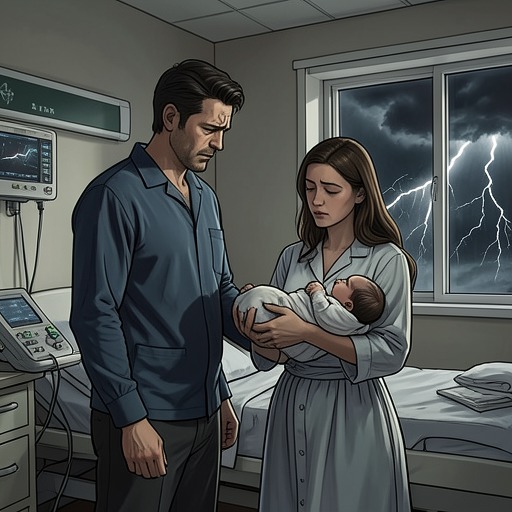
Peter and Eva’s Involuntary Childlessness
Nieuwe burenPeter and Eva’s involuntary childlessness is not a single medical condition but a changing crisis: fertility tests identify a male-factor obstacle, the loss of Lieve deepens their grief, and the desire for a child becomes a source of conflict over whose body, consent, and idea of parenthood will prevail. Their efforts move from timed conception and medical investigation toward adoption, then into a reproductive plan whose consequences expose a sharp divide between wanting a child and consenting to become a parent.
Fertility Efforts and Diagnosis
After a year of trying to conceive, Peter and Eva ask their doctor for a referral to a gynecologist. He initially sees no cause for alarm, noting that half of couples conceive within a year and half do not, and recommends tracking Eva’s basal temperature to help identify ovulation. The couple follow this advice closely: Eva measures her temperature each morning at half past six, and a rise of 0.2 degrees Celsius becomes a signal to have sex.
The schedule changes intimacy into a task. Peter describes sex as concentrated on a few days each month, with none during the rest of the cycle, and says he misses the closeness they had before trying for a child. Eva, by contrast, fears giving up on a desire that has come to occupy her completely. She argues that an investigation might uncover a simple, treatable problem, and the disagreement helps bring them back to the doctor.
A gynecological examination finds no apparent abnormalities in Eva. Her temperature records indicate monthly ovulation, and an ultrasound shows no blockages, cysts, or inflammation in her uterus or ovaries. Peter provides two semen samples, each after a period without ejaculation. Both tests show too few sperm and poor motility: the sperm present barely move forward. The diagnosis locates the obstacle in Peter’s fertility, and the couple are told that medical intervention is their remaining route to having a child together.
Grief, Home, and the Family They Imagined
The couple’s childlessness is also inseparable from the loss of Lieve. In conversation with Hetty, Eva tells Peter that his grief can seem invisible to her, as though she is the only one mourning. Peter recognizes the pain and reproach in her expression, but struggles to answer in a way that conveys how much he too wanted to become a father. Their shared future has narrowed, in his account, to childlessness and the death of their daughter; other subjects feel difficult to approach, and silence becomes a familiar presence between them.
Their home had been chosen around an imagined childhood. At Melkweg 1, they expected a child to grow up near a school, daycare, shops, and a planned playground with a football field, half-pipe, climbing tower, and sandbox. Three days after the birth, however, Peter asked the estate agent to put the house back on the market. The couple could no longer face the move, but the house did not sell: the agent reported that prospective buyers were staying put or renting while they waited for the economy to recover. A place selected for family life thus remained part of a future that neither could simply resume.
Adoption and Unequal Hopes
Later, while holding Sem, Eva finds that being near the baby does not hurt as she had feared. She strokes his soft head and tells Rebecca and Steef that they have a beautiful child. Rebecca says she wishes Eva the same happiness, moving Eva to tears. Peter says they will apply to adopt. Eva accepts adoption as the fairest option, but privately retains another hope: carrying and giving birth to a child of her own. The exchange reveals that agreement about pursuing a family does not mean that Peter and Eva have put aside the different meanings they attach to parenthood.
Reproductive Deception and Consent
Eva and Rebecca later devise a plan to increase the chance of conception through partner-swapping. They intend to calculate Eva’s next ovulation and arrange for the encounter then, repeating it if necessary. When Eva asks about condoms, Rebecca answers that one could leak. The plan treats a possible pregnancy as an outcome the women expect Peter and Steef to accept, rather than a decision to be discussed with them beforehand.
After a condom accident, Steef brings Eva a white box from a late-night pharmacy and urges her to take what he has obtained. He calls the incident his fault, describes a bond and intimacy between them, and says he does not want another child. He explains that Sem was conceived against his will and that, despite trying to be a good father, he considers himself too unstable and too attached to his freedom. His response makes the stakes of the earlier plan concrete: the same pregnancy that might answer Eva’s longing could be an unwanted imposition on Steef.
The concealed arrangement is eventually exposed. Steef accuses Eva and Rebecca of stealing his semen with Rebecca’s consent and calls what they did criminal. He insists that he has the right not to want a child and invokes the importance of a father, while also saying that he does not consider himself a proper father to Sem. The conflict gives Peter and Eva’s struggle a consequence beyond their marriage: the pursuit of parenthood has become bound up with another person’s reproductive autonomy, and the hope for a child cannot be separated from the question of who has agreed to bear the responsibilities that follow.